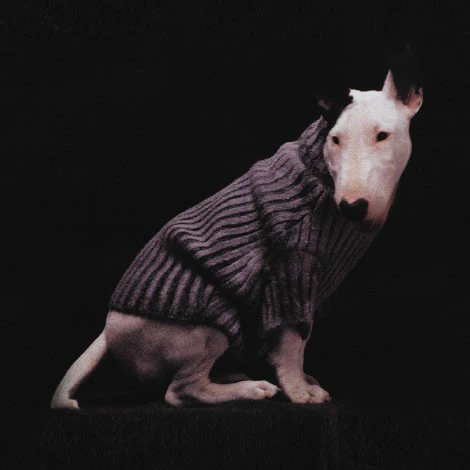
In this issue, we explore the phenomenon from a textile perspective. Cute has a set of identifiable characteristics, one of which is scale. A fascination with small and childlike miniaturisation is seen at its zenith in Queen Mary’s Dollhouse, mini-me mother-and-daughter dressing, and the slippery softness of petroleum plushies. Jonathan Faiers chronicles the evolution of faux fur from its origins in Titus Salt’s experiments with brushed alpaca at the Saltaire Mill in Yorkshire to the Unreal Fur x Sans Beast collaboration, inspired by Where The Wild Things Are. Cute takes different forms in different regions and can be represented in the familiarity of folk culture, Latvian mittens, Scottish bonnets, and Mexican piñatas.
This is where things get complex. Cuteness is a manipulation designed to activate our protective instinct, but not only small babies and animals trigger it. Deena Beverly explores how anthropomorphic representations in everything from teddy bears to taxidermy can be repellent and appealing at the same time. Like the funniest jokes, the ones with a grain of truth make the unpalatable palatable. Cuteness offers us a way to conceal and expose, to be perfect and vulnerable, and to be irresistible yet anarchic simultaneously. It is also tied up with a sexless femininity, originating in Japanese schoolgirls’ innocent love of stationery in the 1990s. Feminine romanticism in saccharine palettes, pretty embroidery, and coquette silhouettes are all celebrated in collections of brands worldwide, from Illogical Poetry to La Casita de Wendy. When the latter’s founder, Ines Aguilar, chose to adopt AI technology to produce an economically and environmentally sustainable sampling strategy, she also added to the sense of unease, both innovative and disturbing, drawing in the viewer in an unsettling way.
The zeitgeist of a troubling world has brought cute to the forefront, where it has infiltrated our society. There is no sign of it shifting as demure sweeps paranoid social media this summer. We retreat to a safe space where the emoji rules.
\nPolly Leonard
\nEditor
\n\n
- \n
- Selvedge magazine comprises of 96 pages. \n
- Size 24 cm x 24 cm. \n
- Printed with soy-based inks on FSC certified paper which has been produced in an environmentally friendly, socially responsible and economically viable manner. \n
- Sent in biodegradable packaging. \n \n
- If you ordered a digital download of an issue, the link will be sent to you within 72 hours of your order. \n
- Shipping is included in your order. Print issues and Selvedge goods are sent by standard second class/international post for which we advise the delivery to the UK can take up to 14 days, Europe up to 21 days and Rest of World up to 28 days. In-transit tracking is not available. Orders of six of more back issues are sent via a tracked service. \n

















Issue 121 Adorable

As this issue goes to press, memes about being “mindful and demure” are flooding the internet. But kawaii, the Japanese culture of cute, arguably a cousin of demure, has held a paradoxically strong cultural presence for decades, incorporating the non-threatening traits of shyness, embarrassment, vulnerability, darlingness, and lovability. It is a significant influence on social media – driven trends, with a reach that rivals Cottagecore and Coquette. Visitor numbers at Cute, an exhibition that explored the extraordinary and complex power of cuteness in contemporary culture earlier in the year at Somerset House, testify to this popularity. The cute aesthetic that drives a protective instinct over babies and small dogs has been commercialised to the point where it “reduces price sensitivity, which makes us happier to hand over money,” suggests Rhik Samadder in the Observer. The recent sold-out Selfridge’s popup installation, Jellycat’s Fish & Chips London Van, where a full “meal” costs around £200, proves this point.
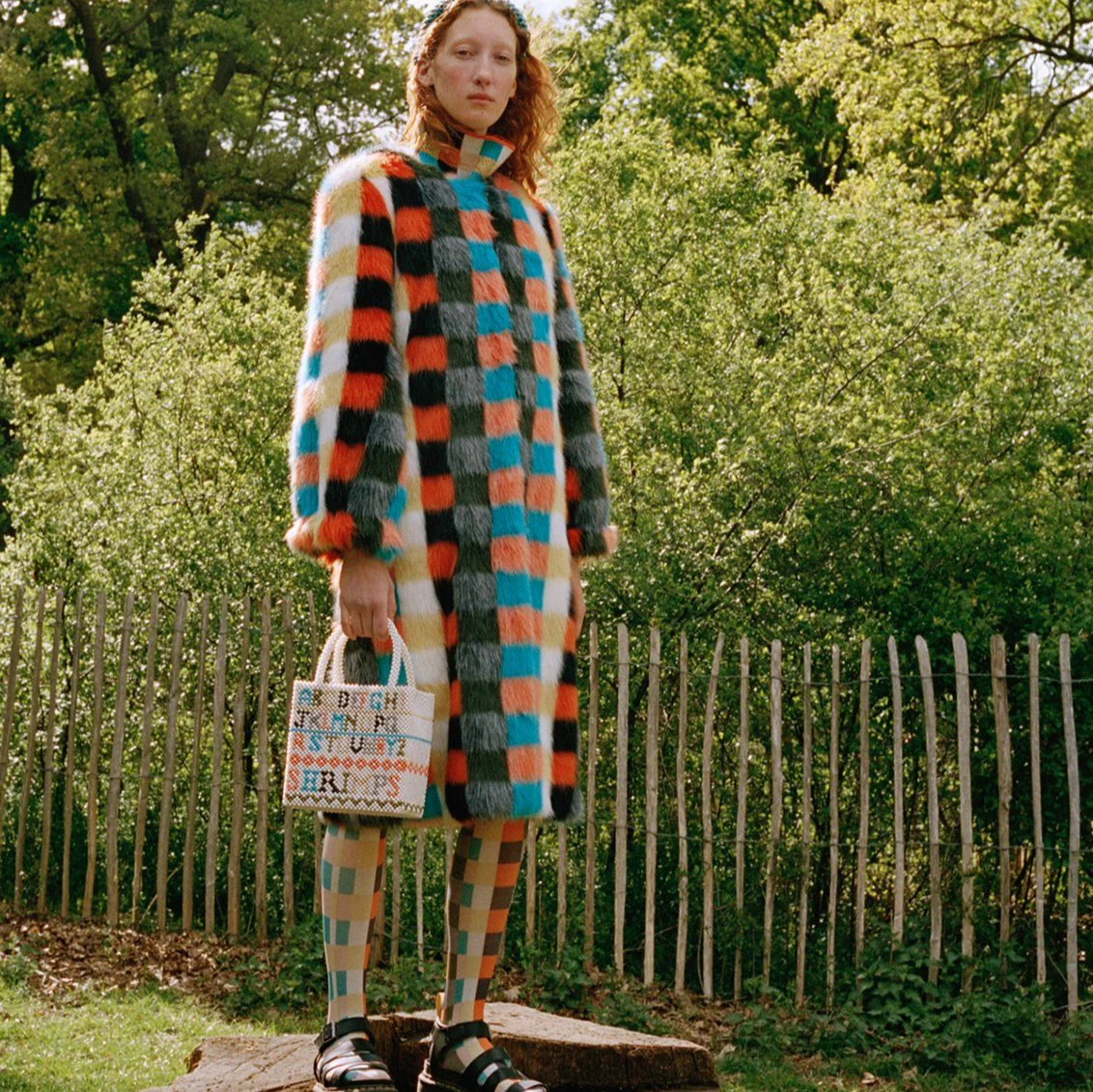
In this issue, we explore the phenomenon from a textile perspective. Cute has a set of identifiable characteristics, one of which is scale. A fascination with small and childlike miniaturisation is seen at its zenith in Queen Mary’s Dollhouse, mini-me mother-and-daughter dressing, and the slippery softness of petroleum plushies. Jonathan Faiers chronicles the evolution of faux fur from its origins in Titus Salt’s experiments with brushed alpaca at the Saltaire Mill in Yorkshire to the Unreal Fur x Sans Beast collaboration, inspired by Where The Wild Things Are. Cute takes different forms in different regions and can be represented in the familiarity of folk culture, Latvian mittens, Scottish bonnets, and Mexican piñatas.
This is where things get complex. Cuteness is a manipulation designed to activate our protective instinct, but not only small babies and animals trigger it. Deena Beverly explores how anthropomorphic representations in everything from teddy bears to taxidermy can be repellent and appealing at the same time. Like the funniest jokes, the ones with a grain of truth make the unpalatable palatable. Cuteness offers us a way to conceal and expose, to be perfect and vulnerable, and to be irresistible yet anarchic simultaneously. It is also tied up with a sexless femininity, originating in Japanese schoolgirls’ innocent love of stationery in the 1990s. Feminine romanticism in saccharine palettes, pretty embroidery, and coquette silhouettes are all celebrated in collections of brands worldwide, from Illogical Poetry to La Casita de Wendy. When the latter’s founder, Ines Aguilar, chose to adopt AI technology to produce an economically and environmentally sustainable sampling strategy, she also added to the sense of unease, both innovative and disturbing, drawing in the viewer in an unsettling way.
The zeitgeist of a troubling world has brought cute to the forefront, where it has infiltrated our society. There is no sign of it shifting as demure sweeps paranoid social media this summer. We retreat to a safe space where the emoji rules.
Polly Leonard
Editor
- Selvedge magazine comprises of 96 pages.
- Size 24 cm x 24 cm.
- Printed with soy-based inks on FSC certified paper which has been produced in an environmentally friendly, socially responsible and economically viable manner.
- Sent in biodegradable packaging.
- If you ordered a digital download of an issue, the link will be sent to you within 72 hours of your order.
- Shipping is included in your order. Print issues and Selvedge goods are sent by standard second class/international post for which we advise the delivery to the UK can take up to 14 days, Europe up to 21 days and Rest of World up to 28 days. In-transit tracking is not available. Orders of six of more back issues are sent via a tracked service.
Original: $32.16
-65%$32.16
$11.26Product Information
Product Information
Shipping & Returns
Shipping & Returns
Description
As this issue goes to press, memes about being “mindful and demure” are flooding the internet. But kawaii, the Japanese culture of cute, arguably a cousin of demure, has held a paradoxically strong cultural presence for decades, incorporating the non-threatening traits of shyness, embarrassment, vulnerability, darlingness, and lovability. It is a significant influence on social media – driven trends, with a reach that rivals Cottagecore and Coquette. Visitor numbers at Cute, an exhibition that explored the extraordinary and complex power of cuteness in contemporary culture earlier in the year at Somerset House, testify to this popularity. The cute aesthetic that drives a protective instinct over babies and small dogs has been commercialised to the point where it “reduces price sensitivity, which makes us happier to hand over money,” suggests Rhik Samadder in the Observer. The recent sold-out Selfridge’s popup installation, Jellycat’s Fish & Chips London Van, where a full “meal” costs around £200, proves this point.
In this issue, we explore the phenomenon from a textile perspective. Cute has a set of identifiable characteristics, one of which is scale. A fascination with small and childlike miniaturisation is seen at its zenith in Queen Mary’s Dollhouse, mini-me mother-and-daughter dressing, and the slippery softness of petroleum plushies. Jonathan Faiers chronicles the evolution of faux fur from its origins in Titus Salt’s experiments with brushed alpaca at the Saltaire Mill in Yorkshire to the Unreal Fur x Sans Beast collaboration, inspired by Where The Wild Things Are. Cute takes different forms in different regions and can be represented in the familiarity of folk culture, Latvian mittens, Scottish bonnets, and Mexican piñatas.
This is where things get complex. Cuteness is a manipulation designed to activate our protective instinct, but not only small babies and animals trigger it. Deena Beverly explores how anthropomorphic representations in everything from teddy bears to taxidermy can be repellent and appealing at the same time. Like the funniest jokes, the ones with a grain of truth make the unpalatable palatable. Cuteness offers us a way to conceal and expose, to be perfect and vulnerable, and to be irresistible yet anarchic simultaneously. It is also tied up with a sexless femininity, originating in Japanese schoolgirls’ innocent love of stationery in the 1990s. Feminine romanticism in saccharine palettes, pretty embroidery, and coquette silhouettes are all celebrated in collections of brands worldwide, from Illogical Poetry to La Casita de Wendy. When the latter’s founder, Ines Aguilar, chose to adopt AI technology to produce an economically and environmentally sustainable sampling strategy, she also added to the sense of unease, both innovative and disturbing, drawing in the viewer in an unsettling way.
The zeitgeist of a troubling world has brought cute to the forefront, where it has infiltrated our society. There is no sign of it shifting as demure sweeps paranoid social media this summer. We retreat to a safe space where the emoji rules.
Polly Leonard
Editor
- Selvedge magazine comprises of 96 pages.
- Size 24 cm x 24 cm.
- Printed with soy-based inks on FSC certified paper which has been produced in an environmentally friendly, socially responsible and economically viable manner.
- Sent in biodegradable packaging.
- If you ordered a digital download of an issue, the link will be sent to you within 72 hours of your order.
- Shipping is included in your order. Print issues and Selvedge goods are sent by standard second class/international post for which we advise the delivery to the UK can take up to 14 days, Europe up to 21 days and Rest of World up to 28 days. In-transit tracking is not available. Orders of six of more back issues are sent via a tracked service.