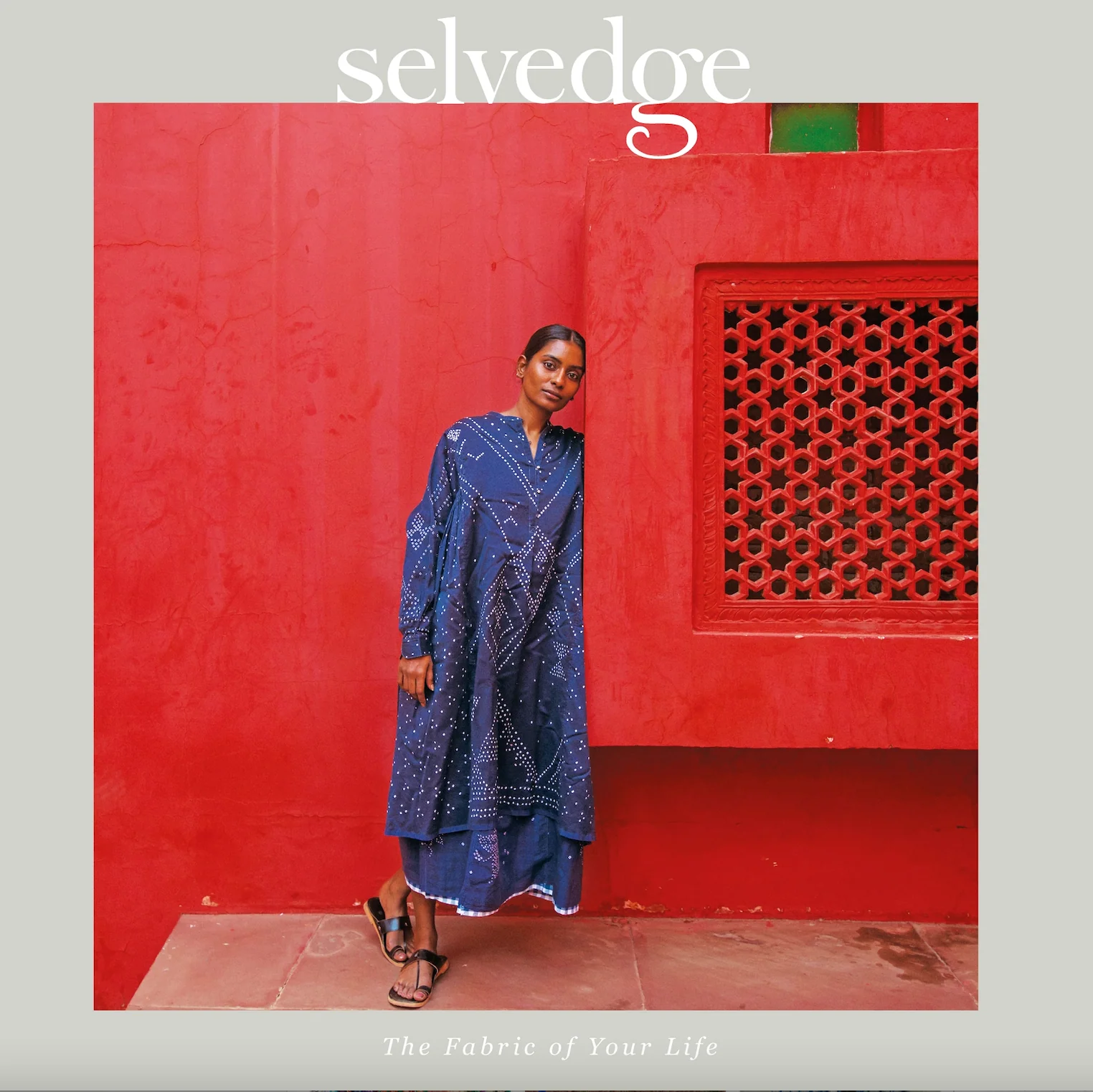



Issue 117 Irresistible - please note this issue is only available as a digital issue
Please note this issue is only available as a digital issue.
March / April 2024
For Mira Gupta, as she writes in her article “Lessons in Chemistry,” “There’s something thrilling about resist dyeing. You control the dye but not the result. It’s like controlled chaos, a surprise party in every vat.” Such a boldly colourful assertion prompted me to question what it is it about resist dyeing that makes it irresistible.
When Portuguese explorer Vasco da Gama brought vibrant hand-painted palampores back from India in 1498, Europeans, used to humble wool, linen, and hemp, were mesmerised. This was the beginning
of a violent trade that climaxed 100 years later with the establishment of various “East India Companies” and the peaking of the “calico craze,” in the late 17th century. So, is it the spectrum available via
a mordant-and-resist sequence that makes resist dyeing irresistible?
Remember, indigo is a pigment dye, impossible to apply to the surface of cloth using a brush or a block. So, to achieve a blue and white design, it is necessary to create a mechanical or chemical resist and submerge the cloth in a dye bath. In her article “True Blue,” Liz Hoggard uncovers contemporary brands mastering the techniques to produce slow fashion favourites. Is it an abundance of the world’s favourite colour combinations that makes resist dye irresistible?
Human beings are hard-wired to find patterns everywhere. Patterns created through resist dyeing are found all over the world, and from intricate multi-coloured ikat in Uzbekistan and the 16-stage process used to create Ajrak in Gujarat. Is it the place it holds in much of humanity’s intangible cultural heritage that makes resist dyeing irresistible?
2024 is the International Year of Batik, see batikinternational.com for details, and in this issue, collector Rudolf Smend explains why he is drawn to the apex of the craft practices in Indonesia. Yet this one technique has many forms of expression, from the Arabic-inspired designs of Nazek Hamdi to the precise patterns achieved in Miao batik from China. Is it its versatility that makes resist dying irresistible?
I would love to learn what makes resist dyeing irresistible for you. Post an image of a special textile on Instagram and tag us with the hashtag #IrresistibleResist.
Polly Leonard
Editor
Published on 15 February.
- Selvedge magazine comprises of 96 pages.
- Size 24 cm x 24 cm.
- Printed with soy-based inks on FSC certified paper which has been produced in an environmentally friendly, socially responsible and economically viable manner.
- Sent in biodegradable packaging.
- If you ordered a digital download of an issue, the link will be sent to you within 72 hours of your order.
- Shipping is included in your order. Print issues and Selvedge goods are sent by standard second class/international post for which we advise the delivery to the UK can take up to 14 days, Europe up to 21 days and Rest of World up to 28 days. In-transit tracking is not available. Orders of six of more back issues are sent via a tracked service.
Original: $32.16
-65%$32.16
$11.26Product Information
Product Information
Shipping & Returns
Shipping & Returns
Description
Please note this issue is only available as a digital issue.
March / April 2024
For Mira Gupta, as she writes in her article “Lessons in Chemistry,” “There’s something thrilling about resist dyeing. You control the dye but not the result. It’s like controlled chaos, a surprise party in every vat.” Such a boldly colourful assertion prompted me to question what it is it about resist dyeing that makes it irresistible.
When Portuguese explorer Vasco da Gama brought vibrant hand-painted palampores back from India in 1498, Europeans, used to humble wool, linen, and hemp, were mesmerised. This was the beginning
of a violent trade that climaxed 100 years later with the establishment of various “East India Companies” and the peaking of the “calico craze,” in the late 17th century. So, is it the spectrum available via
a mordant-and-resist sequence that makes resist dyeing irresistible?
Remember, indigo is a pigment dye, impossible to apply to the surface of cloth using a brush or a block. So, to achieve a blue and white design, it is necessary to create a mechanical or chemical resist and submerge the cloth in a dye bath. In her article “True Blue,” Liz Hoggard uncovers contemporary brands mastering the techniques to produce slow fashion favourites. Is it an abundance of the world’s favourite colour combinations that makes resist dye irresistible?
Human beings are hard-wired to find patterns everywhere. Patterns created through resist dyeing are found all over the world, and from intricate multi-coloured ikat in Uzbekistan and the 16-stage process used to create Ajrak in Gujarat. Is it the place it holds in much of humanity’s intangible cultural heritage that makes resist dyeing irresistible?
2024 is the International Year of Batik, see batikinternational.com for details, and in this issue, collector Rudolf Smend explains why he is drawn to the apex of the craft practices in Indonesia. Yet this one technique has many forms of expression, from the Arabic-inspired designs of Nazek Hamdi to the precise patterns achieved in Miao batik from China. Is it its versatility that makes resist dying irresistible?
I would love to learn what makes resist dyeing irresistible for you. Post an image of a special textile on Instagram and tag us with the hashtag #IrresistibleResist.
Polly Leonard
Editor
Published on 15 February.
- Selvedge magazine comprises of 96 pages.
- Size 24 cm x 24 cm.
- Printed with soy-based inks on FSC certified paper which has been produced in an environmentally friendly, socially responsible and economically viable manner.
- Sent in biodegradable packaging.
- If you ordered a digital download of an issue, the link will be sent to you within 72 hours of your order.
- Shipping is included in your order. Print issues and Selvedge goods are sent by standard second class/international post for which we advise the delivery to the UK can take up to 14 days, Europe up to 21 days and Rest of World up to 28 days. In-transit tracking is not available. Orders of six of more back issues are sent via a tracked service.